
IoT-Based Flood Monitoring and Early Warning Systems: How They Work
By Pathibhara Solutions · Published September 21, 2026
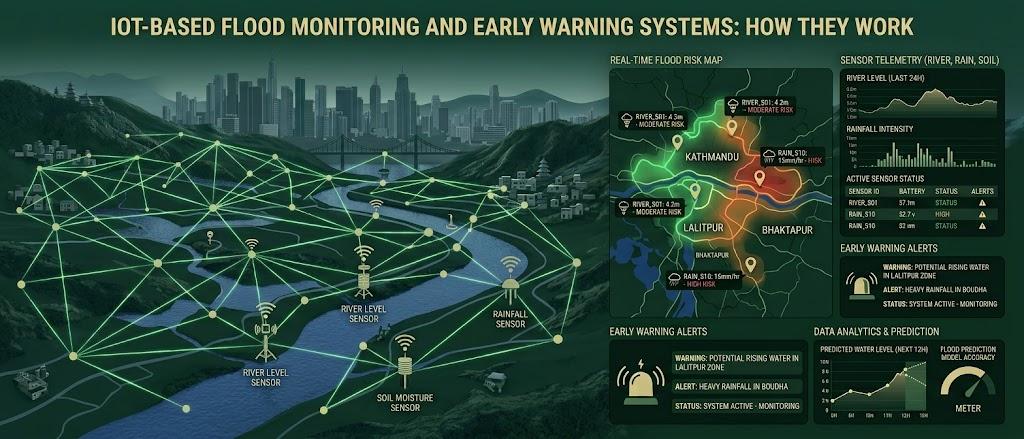
IoT-based flood monitoring systems use sensors, communication networks, and real-time data to monitor water levels and provide early warnings when conditions require attention.
IoT-Based Flood Monitoring and Early Warning Systems: How They Work
Flooding can happen quickly, making timely information important for communities, authorities, and organizations in areas at risk of rising water levels. IoT-based flood monitoring systems use sensors, communication networks, and monitoring platforms to continuously collect water-level data and provide early warnings when conditions become critical.
What Is an IoT-Based Flood Monitoring System?
An IoT-based flood monitoring system uses connected sensors to measure changes in water levels and send the collected information to a remote monitoring platform.
Instead of relying only on manual observation, sensors can continuously monitor rivers, streams, reservoirs, or other water sources and provide data from remote locations.
How Does It Work?
An IoT flood monitoring system generally works through four main steps:
1. Water-Level Measurement
A sensor is installed near or above a water source to measure the distance between the sensor and the water surface. Non-contact radar sensors can be used for this purpose without requiring direct contact with the water.
2. Data Transmission
The sensor sends the collected measurements through a communication network. Depending on the location and system requirements, technologies such as LoRaWAN, NB-IoT, or 4G can be used.
3. Data Monitoring
The collected information is sent to a monitoring platform where users can view current and historical water-level data. This allows authorities or organizations to monitor conditions remotely.
4. Early Warning Alerts
The system can use predefined water-level thresholds to identify potentially dangerous conditions. When a threshold is reached, the system can generate an alert so that responsible users can take appropriate action.
Why Early Warning Matters
One of the main benefits of automated flood monitoring is continuous observation. A monitoring system can collect information even when there is no one physically present at the site.
Early warnings can help organizations:
- Monitor rising water levels
- Identify changes in conditions
- Receive alerts remotely
- Support emergency planning
- Reduce dependence on manual observation
- Make decisions using real-time data
However, an early warning system is only one part of flood preparedness. Alerts should be combined with appropriate emergency procedures and local response plans.
Where Can Flood Monitoring Systems Be Used?
IoT-based flood monitoring can be used in different locations, including:
- Rivers and streams
- Flood-prone communities
- Reservoirs and dams
- Bridges and drainage areas
- Agricultural areas
- Infrastructure and construction sites
The system can be adapted according to the environment, monitoring range, connectivity, and power requirements of each location.
Power and Remote Monitoring
Flood monitoring locations may be far from reliable electricity sources. IoT monitoring devices can therefore be designed with solutions such as solar power and battery backup for remote deployments.
This allows monitoring equipment to continue collecting and transmitting data without requiring a permanent electrical connection at every installation site.
The Role of IoT in Flood Management
IoT makes it possible to connect physical sensors with digital monitoring platforms. Instead of collecting water-level information manually at fixed intervals, connected sensors can provide continuous data that can be viewed remotely.
When combined with threshold-based alerts, this can help organizations respond to changing water conditions more quickly and improve overall flood-monitoring processes.
Conclusion
IoT-based flood monitoring systems combine water-level sensors, connectivity, monitoring platforms, and automated alerts to provide continuous information about changing water conditions.
By enabling remote monitoring and early warnings, these systems can support flood preparedness and help organizations make more informed decisions when water levels begin to rise.