What Is IoT and How Is It Used in Smart Monitoring Systems?
By Pathibhara Solutions · Published September 21, 2026
The Internet of Things connects physical devices and sensors to digital platforms for collecting and sharing data. Learn how IoT is used in smart monitoring systems and connected solutions.
What Is IoT and How Is It Used in Smart Monitoring Systems?
The Internet of Things (IoT) is changing the way businesses, organizations, and communities monitor and manage physical systems. From environmental monitoring to smart buildings and connected devices, IoT allows physical devices to collect, exchange, and use data through connected networks.
But what exactly is IoT, and how does it support smart monitoring systems?
What Is IoT?
IoT stands for Internet of Things. It refers to physical devices that are connected to a network and can collect, transmit, or exchange data.
These devices can include sensors, cameras, GPS trackers, meters, controllers, and other connected equipment.
For example, a temperature sensor can measure environmental conditions and send the information to a monitoring platform. Similarly, a water-level sensor can monitor changes in water levels and send alerts when a predefined threshold is reached.
How Does IoT Work?
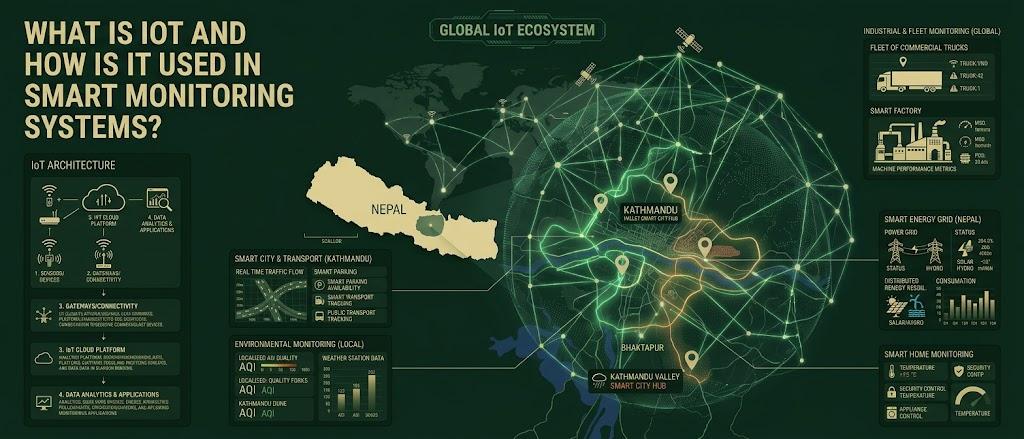
A basic IoT system generally involves four main components:
1. Sensors and Devices
Sensors collect information from the physical environment. Depending on the application, they may measure temperature, humidity, water level, electricity consumption, location, motion, or other conditions.
2. Connectivity
The collected data needs to reach a monitoring system. IoT devices can use technologies such as Wi-Fi, cellular networks, LoRaWAN, NB-IoT, or other communication methods depending on the application.
3. Data Processing
The collected information is sent to a platform where it can be stored, processed, and analyzed. This allows users to understand current conditions and identify important changes.
4. Monitoring and Alerts
Users can view information through a dashboard or application. IoT systems can also generate alerts when specific conditions are detected, allowing organizations to respond more quickly.
IoT in Smart Monitoring Systems
Smart monitoring systems use connected sensors and devices to continuously collect information from physical environments.
For example, an IoT-based water-level monitoring system can measure water levels and send the data to a remote monitoring platform. If the water level crosses a predefined threshold, the system can generate an alert.
Similarly, an environmental monitoring system can collect information such as temperature, humidity, or air conditions and make that data available remotely.
This reduces the need for manual monitoring and provides access to information from different locations.
Common Applications of IoT Monitoring
IoT can be used in many areas, including:
- Environmental monitoring – monitoring temperature, humidity, weather, and other environmental conditions.
- Water-level monitoring – tracking rivers, reservoirs, tanks, and other water sources.
- Energy monitoring – measuring electricity consumption and identifying usage patterns.
- Fleet monitoring – tracking vehicles, locations, routes, and vehicle activity.
- Smart communities – connecting devices and services to improve monitoring and response.
- Emergency monitoring – using connected devices to detect events and send alerts.
Benefits of IoT-Based Monitoring
IoT-based monitoring can provide several practical benefits.
Real-time information: Connected devices can continuously collect and transmit data.
Remote monitoring: Users can access information without being physically present at the monitoring location.
Faster alerts: Automated alerts can notify users when important conditions are detected.
Reduced manual work: Continuous data collection can reduce the need for frequent manual inspections.
Better decision-making: Historical and real-time data can help organizations understand conditions and make informed decisions.
The Future of Smart Monitoring
As IoT technology continues to develop, more physical systems are becoming connected. Sensors, communication networks, cloud platforms, and intelligent software can work together to create monitoring systems that are more automated and responsive.
The value of IoT is not simply connecting devices to the internet. It is about collecting useful data, making that information accessible, and using it to support better decisions and faster responses.
Conclusion
IoT provides a way to connect physical devices and sensors with digital monitoring systems. By collecting and transmitting real-time information, IoT can support applications ranging from environmental and water-level monitoring to energy, fleet, and emergency systems.
For organizations looking to improve visibility and reduce manual monitoring, IoT-based smart monitoring can provide a practical way to connect physical systems with useful digital information.